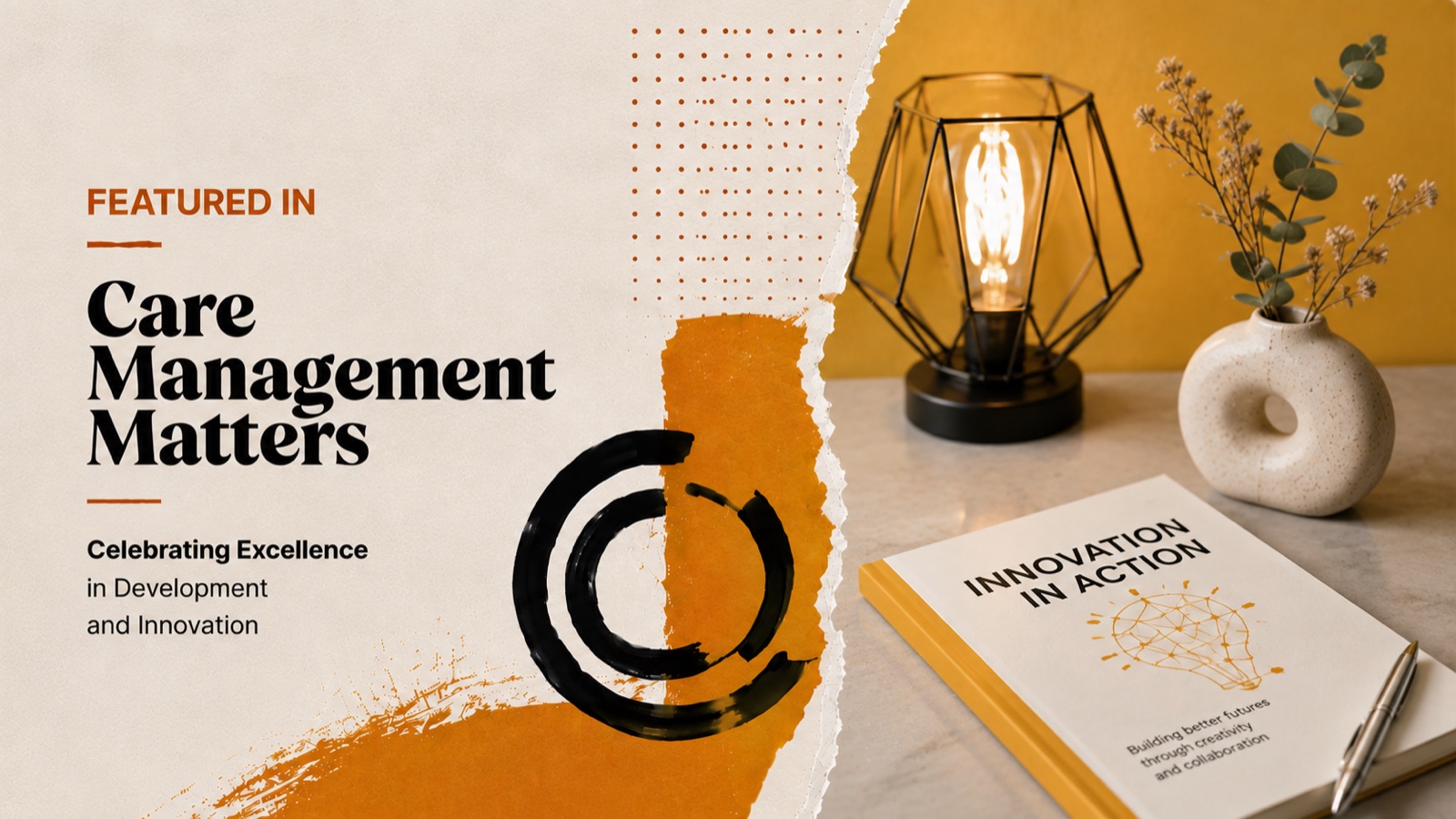
Celebrating Excellence in Development and Innovation | Care Management Matters
Why writing down what we learn, and passing it on, helps the whole sector move forward
In its June 2025 print edition, Care Management Matters magazine published a first-person piece on page 46 by Israa Qaddourah, Marketing and Project Growth Leader at Apax, a supported housing social enterprise in Sydenham, South East London. It followed the VR Wellness Programme's Development and Innovation Award at the Markel 3rd Sector Care Awards 2025.
The piece is a generous one. Rather than simply celebrating, it explains what was tried, what was learned and what comes next, so that others might find something useful in it. That spirit of openness is worth celebrating in its own right.
A Story Told in Print
Seeing an article in a printed magazine carries a particular weight. It sits on desks and in offices, gets passed between colleagues and is read by managers and practitioners across the not-for-profit sector. Print also tends to be read slowly, with time to reflect.
The print edition carried the same piece that had first appeared online in May 2025, giving it a second life and a wider readership. For a small organisation, that kind of reach is a real privilege.
It also reflects something the sector does well. Professional magazines give organisations of every size a place to describe their work honestly, and give readers a chance to learn from one another.
Why Sharing Learning Matters
Every organisation that tries something new gathers knowledge along the way. Some of it is obvious, but much of it is practical detail that only becomes clear once an idea meets real people and real routines. These are often the lessons that matter most to the next organisation.
When that knowledge stays inside one team, others have to discover it again from scratch. When it is written down and shared, it can save time, help avoid repeated mistakes and give someone else the confidence to begin.
Openness also invites challenge and improvement. Publishing what you have learned means others can question it, build on it and adapt it to their own communities, which is how good ideas grow.
Honest About Beginnings
One of the most useful lessons in the article is its candour about resources. Israa wrote that Apax had no external funding at the outset, and that Meta generously donated 10 headsets to make the first phase possible.
A partnership with TRIPP, a VR platform designed for emotional wellbeing and mindfulness, followed soon after. As the article put it, “It was not about having the perfect solution.”
That is an encouraging message for any small provider. Progress does not always wait for ideal conditions, and hearing how a modest start grew can help others feel able to take their own first steps. Being honest about limits can be just as helpful as describing successes.
Learning From Residents
The article describes residents and recovery co-ordinators playing a key role in gathering feedback during a small pilot in winter 2023. Their insight helped adapt the programme to real needs and refine how it was delivered.
Later, feedback tools were co-designed with residents and support workers. This kind of shared design turns evaluation into a conversation, rather than something done to people without their involvement.
Describing this openly is valuable in its own right. Other providers can see not just the outcome but the process behind it, and perhaps borrow the habit of asking residents first. Small habits like this can travel a long way once they are written down.
Recognition as an Invitation
Awards are often seen as an ending, a moment to celebrate before moving on. They can also be a beginning, opening doors to conversations with people who want to know more about the work.
You can read more about Apax winning the Markel 3rd Sector Award for Development and Innovation in our Awards section. The magazine article used that recognition as a chance to explain the work, not simply to announce it.
That approach feels right for a sector built on collaboration. Recognition shared in this way becomes something others can use, rather than something kept quietly on a shelf. It also keeps the attention on residents rather than on the prize.
Plans to Share More Widely
The article also looked ahead. It described plans to develop a dedicated VR Wellness website to share updates, resources and learning, so that the knowledge gathered so far can reach others more easily. A shared home for learning makes it easier for others to find what they need.
It mentioned exploring how the programme could be scaled across other supported housing services, charities and NHS-aligned settings, and using VR for staff training as well as for residents.
Each of these plans rests on the same principle. What works in one setting is worth offering to others, with the humility to accept that it will always need adapting along the way.
A Shared Conversation
No organisation has all the answers, and the most valuable learning often comes from peers facing similar questions. Magazines like this one help that learning travel further than any single team could manage alone.
Apax is grateful to Care Management Matters for giving the piece space in print, and to Markel and the National Care Forum for the awards that prompted it.
You can read the full article by Israa Qaddourah in Care Management Matters: Celebrating excellence in Development and Innovation.